How to Build a Strong Sense of Belonging in a Boarding House
A successful boarding house is more than a place where students sleep.
At its best, it becomes a community where young people feel known, valued and included.
That sense of belonging doesn’t happen automatically. Students may live in the same building without ever truly feeling part of it.
For boarding tutors and houseparents, creating belonging is one of the most important parts of pastoral care.
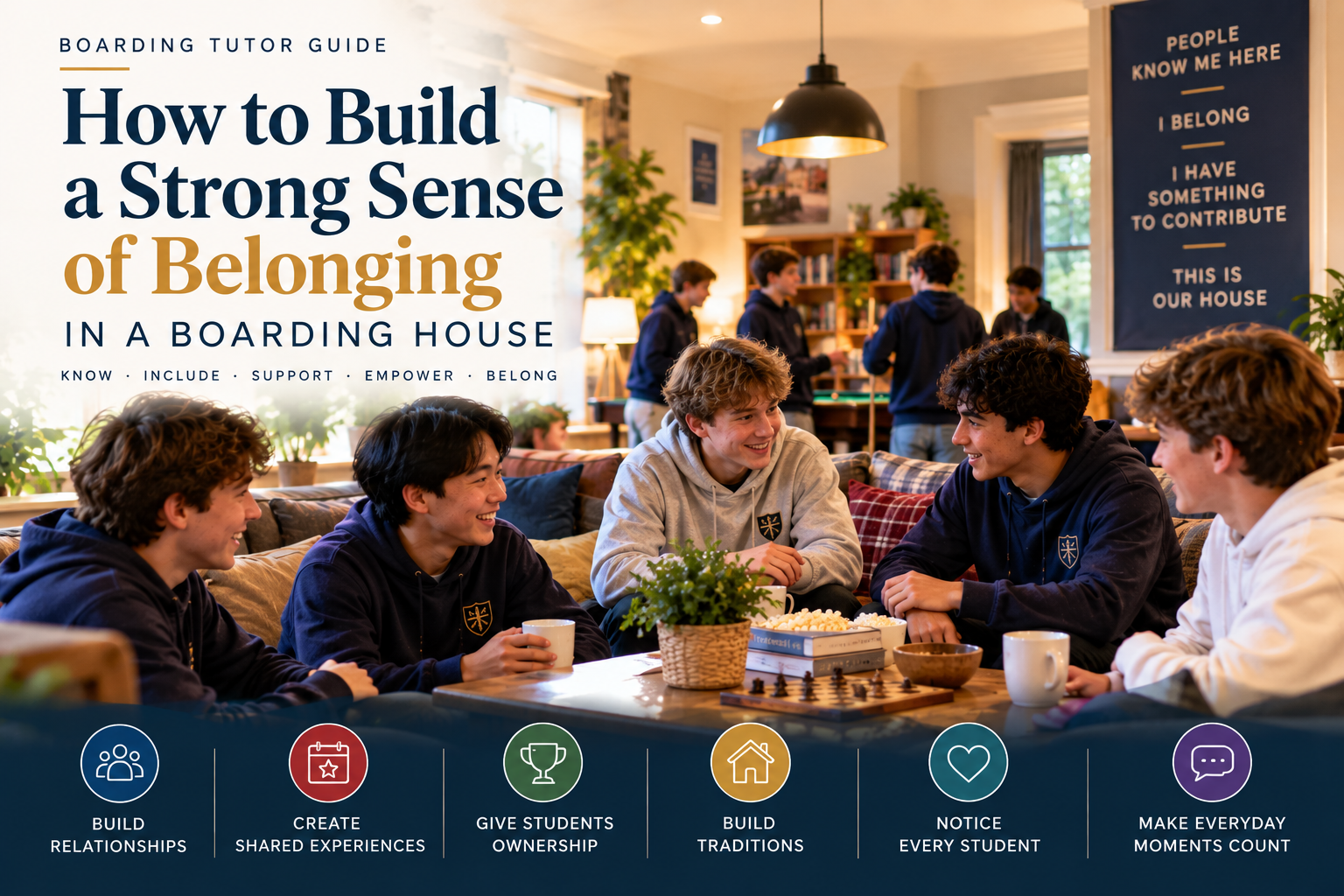
Here are six practical ways to build it.
1. Know the Student, Not Just the Name
Students notice when adults take a genuine interest in them.
Learn what they enjoy.
What sport do they play? What music do they listen to? What are they good at? What makes them laugh? What are they looking forward to?
Small conversations build relationships.
A student who feels known is far more likely to approach staff when something isn’t right.
2. Create Shared Experiences
Communities develop through experiences.
House activities, competitions, trips, cooking evenings, sports and simple games give students opportunities to interact outside their normal friendship groups.
The activity itself doesn’t need to be spectacular.
A table tennis competition or pizza evening can create more connection than an expensive excursion.
What matters is that students experience something together.
3. Give Students Ownership
A boarding house shouldn’t feel like something adults operate and students simply live in.
Ask students:
What activities should we run?
What could make the common room better?
What house event would you organise?
Let them lead activities, organise competitions or welcome new students.
Ownership creates investment.
When students begin saying “our house” rather than “the boarding house,” something important has changed.
4. Build Traditions
Traditions create identity.
They might include:
- birthday celebrations
- Sunday breakfast
- house competitions
- end-of-term dinners
- movie nights
- international food evenings
- staff vs student matches
- annual awards
- a house photo
- welcoming rituals for new students
Traditions don’t need to be complicated.
They simply need to belong to the community.
Students remember them long after they leave.
5. Notice Who Is Missing
Belonging isn’t measured by how much fun the most sociable students are having.
Look at who isn’t there.
Who rarely comes into the common room?
Who always eats alone?
Who avoids house activities?
Who hasn’t formed strong friendships?
Who disappears into their bedroom every evening?
Don’t force participation.
Instead, keep offering opportunities.
Sometimes belonging begins with something as simple as:
“We’re making pancakes downstairs. Come and help.”
6. Make Everyday Moments Matter
Not every meaningful pastoral interaction needs a formal meeting.
Some of the best conversations happen while making tea, walking to dinner, watching football or sitting in the common room.
Boarding gives staff something classroom teachers rarely have:
time around students when nothing formal is supposed to happen.
Use it.
These ordinary moments are where trust is often built.
Belonging Changes Everything
When students feel that they belong, they are more likely to participate, communicate and support one another.
They begin looking after the community because the community matters to them.
A strong boarding house isn’t necessarily the one with the newest facilities or the busiest programme.
It is the house where students walk through the door and feel:
People know me here.
People notice when I’m missing.
I have something to contribute.
This is my community.
That is what turns a building into a boarding home.
Build Stronger Boarding Communities
Regular house activities are one of the simplest ways to create shared experiences and strengthen relationships between boarding students.
Boarding School Activities: 50 Ready-to-Run House Evening Activities from Lumina Learning House provides practical activities designed specifically for boarding tutors, houseparents and residential staff.
Use them for house evenings, community building, weekends and those nights when you need something engaging and ready to run.
Explore 50 Ready-to-Run Boarding House Activities on Teachers Pay Teachers